

Pallet Racking FAQ
Pallet racking is widely used as a way to maximise storage within a warehouse or commercial storage environment. Here we answer some of the most frequently asked questions about pallet racking.
What is pallet racking used for?

Pallet racking’s main purpose is to provide a safe and efficient means of storage and handling for boxed, crated, and containerised goods and materials in a warehouse type environment. Pallet racking cannot be used for storage and handling of bulk materials unless these are packaged accordingly. Pallet racking systems are commonly used in warehouses in order to provide optimised storage capacity with a minimum infrastructural footprint – i.e., it increases the facility’s storage density.
The correct use of pallet racking allows a warehouse to operate more efficiently as client order processing time is reduced. The use of pallet racking also cuts down on labour-intensive daily operations as goods and materials are easily located and manipulated within the facility. There are no real restrictions as to what goods and materials can be stored on pallet racks as long as these are properly packed and secured, and do not exceed the structure’s load bearing capacity. There are different types of pallet racking available, with each type varying in terms of layout, construction, size, and load tolerances. In summary, choosing the correct type of pallet racking is crucial to ensuring risk-free daily operations.
How does pallet racking work?
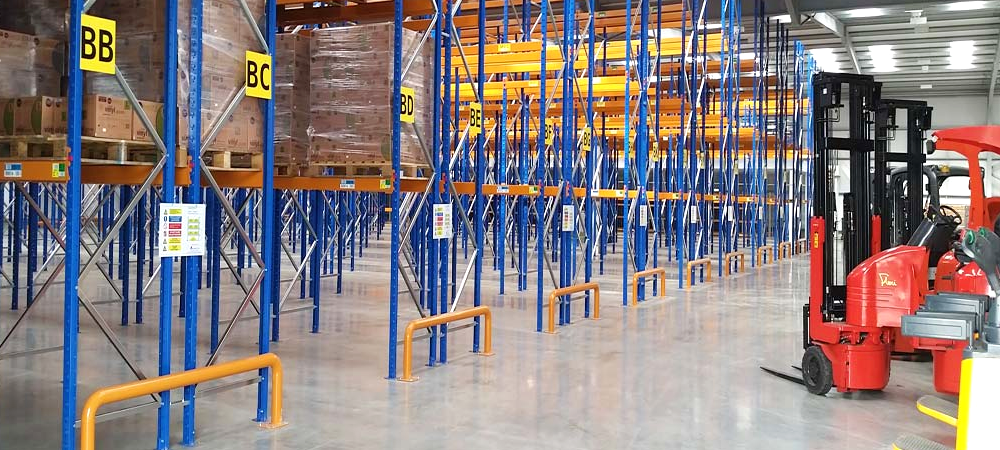
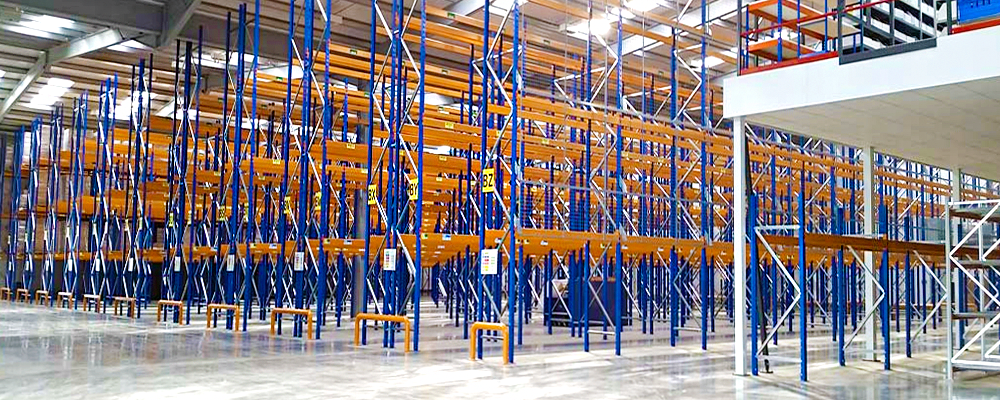
Essentially, pallet racking is a structure which allows storage of goods and materials in horizontal rows (shelves) and over multiple levels. In its more basic form, pallet racking is just a heavy duty set of shelves. However, there is much more to it than meets the eye. Pallet racking is made up of a number of main structural elements, namely load beams, upright frames, braces (horizontal or diagonal), pallet supports, and decking. The way pallet racking works is brilliantly simple.
Pallet racking’s capacity is best utilised by using a forklift or other similar machine that is able to lift, remove, push, pull or otherwise shift packaged goods (including self-contained pallets) and materials on and off the racks. Pallet racking gives operators lots of options when it comes to modifying the structure as shelving can be lifted or lowered in order to accommodate specific size loads.
Pallet racking’s footprint can also be modified as needed; it can be extended or reshaped based on current needs. The height of the racking can also be adjusted accordingly, though any changes to height must be within the structure’s safe load and height tolerances.
What is the most common type of
pallet racking?
Perhaps the most common type of pallet racking in use today is selective pallet racking. Selective pallet racking systems come in two main configurations – roll formed (also called clip-on), and structural (known as bolt together).
Selective pallet racking is worked with forklifts or other similar equipment. There are many reasons why selective racking systems have become the most widely used format today. For instance, this configuration fully supports the FIFO loading and unloading principle (the first in, first out method).
It must be noted that for the safe and efficient use of selective racking systems a linear clearance (floor space) of 3.5m must be available between aisles when reach trucks are in use. In the case of counterbalanced forklifts, the linear clearance between aisles must be 4.5m. Selective racking provides operators with unrestricted access to any pallet or crate on the racks. It also allows for efficient order picking at any of the lower levels, making everyday operations swifter and more cost effective. Selective pallet racking yields about 90% storage utilisation, so for every 100 pallet spaces on the rack, operators can effectively store 90 units. Selective racking works well with low number SKUs.
Can I change the configuration of pallet racking after installation?
Some pallet racking systems allow for changes to their configuration after being installed. The scale to which a pallet racking can be modified post installation will vary on the type of system, its size and height, and additional elements and/or accessories. Usually, the manufacturer or installer would provide guidance on what alteration can be done by operators, and what needs to be done by qualified professionals. As always, the main concern is safety, so any structural changes to the racking must be within the prescribed tolerances.
Generally, shelving and horizontal beams tend to be mobile on many racking systems. When altering the layout of load bearing elements or adding and moving aisles to the structure, you definitely need to consult with licensed professionals, or speak to the company that installed or maintains your system. Changes to the configuration of a pallet rack may also alter its load bearing ability which is a compelling argument in and of itself to use qualified professionals for the job. Changing the layout or configuration of your pallet racking will also prove a good opportunity to conduct a thorough inspection of its components so you know where you stand in terms of everyday operational safety.
How is pallet racking installed?
The installation of pallet racking (of any kind) is a two-tier process. Each stage of installation is crucial and must be carried out by qualified individuals. The first stage of the installation process involves the preparation and analysis of existing infrastructure. Here, specialist installers determine the safest and most efficient way to erect the selected type of pallet racking. The analysis is based on a number of variables like flooring suitability, plant and equipment use, etc. If engineers have given the go ahead for installation, then the actual construction process may begin.
All pallet racking must be erected and secured as per SEMA/FEM regulations. Its construction begins with the frames. The frames are erected from upright beams, braces, and base plates. Once erected, the frame is then secured to the floor using the baseplates and fixings. Next up are the actual racking beams (the horizontal bars). These racking beams are slotted into place, and then fastened to the uprights in different ways depending on the type of racking you opted for as well as its load bearing tolerances. The final stage is to lay the decking (normally wood or metal); again, the type of decking depends on the particular racking system.
What is mobile pallet racking?
Mobile pallet racking is one of the most clever and efficient racking systems in use today. As its name implies, this racking configuration is movable rather than inert. The main purpose of mobile racking is to increase storage capacity even more by further reducing infrastructural footprint. Depending on its power source, mobile racking is also referred to as motorised pallet racking. The general consensus is that a well-designed mobile racking system can increase storage capacity by 50% within the same floor space. Mobile racking ‘creates’ extra storage space by transforming aisles with static access into productive storage space.
In simple terms, the racking units can be bunched together en block (no space between aisles) and spaced out into aisles once access is needed. Mobile racking moves on heavy duty rollers along tracks in the floor, much like a train carriage moves along its train tracks. The racking moves sideways along the tracks. Operating forklifts alongside mobile racking requires approximately 3.5m of linear clearance between racks. The system is perfect for high selectivity in dense storage environments. Generally, mobile racking’s utilisation coefficient is about 90%. This system is commonly used in cold storage.
What is drive in pallet racking?
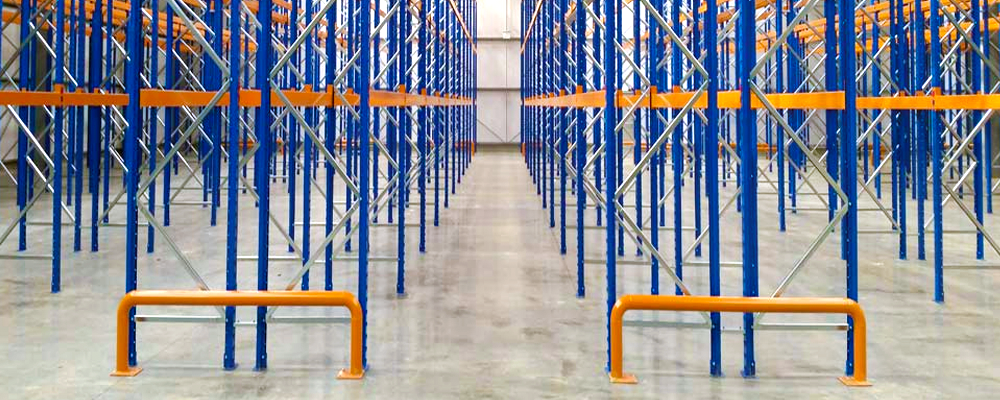
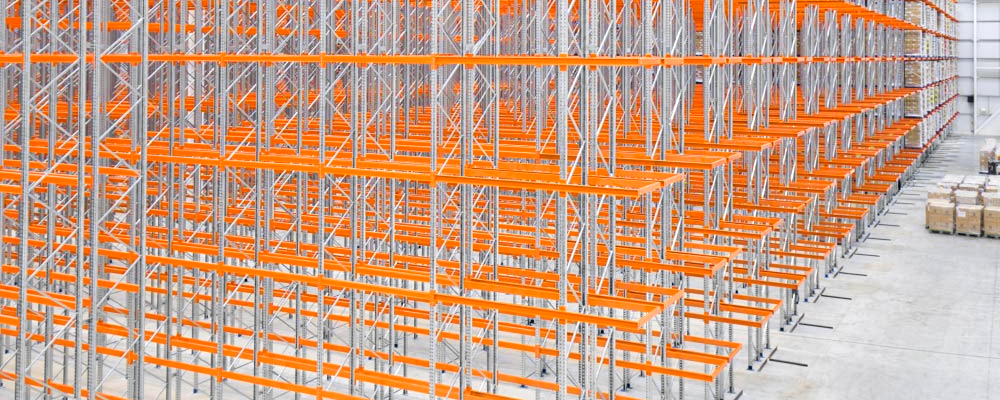
Drive-in pallet racking (also known as drive through in some cases) is a pallet racking system that allows direct forklift access inside the lane of rows (in this instance they are called bays). Whether the system is drive in or drive through depends on the presence of an exit at the other end of each lane/bay.
A drive-in pallet racking system typically uses the LIFO (FILO) principle of last-in-first-out, or first-in-last-out. A drive through pallet racking system uses the FIFO principle (first-in-first-out) as it has an entry and an exit on either end. These pallet racking systems allow for full utilisation of available cubic space as they can be up to 11m in standard height. When using drive in or drive through racking systems, it is advisable to implement ground rails to protect pallets and truck during handling and operation.
Drive-in racking is a good storage solution for heavy pallets and batched goods. The efficient use of this type of pallet racking system does not require specialist handling equipment. Drive in and drive through pallet racks can increase storage capacity by 60% to 80% as compared to standard pallet racking systems.
What is push back pallet racking?
Push back pallet racking is one of the most space efficient and time saving configurations in use today. Push back pallet racking optimises both storage floor space and cubic space. This type of system provides easy access to any type of handling equipment.
Push back pallet racking works in a clever way by allowing palletised goods to be stacked in sequence. Pallet sequences move in and out of the push back racking structure on wheels, rolling in guide rails or tracks. This type of racking is inclined as it uses the force of gravity to roll back pallets due for shifting. This means that the full depth of the structure is being utilised, thus increasing storage capacity.
Push back pallet racking allows for up to four pallets to be stored in sequence. When operators remove one or more of the pallets from a given sequence, the remaining pallets roll forward (through gravity). Push back pallet racking uses the FILO loading/unloading principle as it does not provide frontal access to pallets located in the back of a sequence. This is a system used for full pallet storage only. It provides approximately 85% storage space utilisation.
What is selective pallet racking?
Selective pallet racking is one of the most common pallet racking systems today. The two standard formats of selective pallet racking are roll formed configuration (also known as clip-on system), and the structural configuration (also called bolt-on system).
The roll formed configuration is widely produced in what is known as the ‘teardrop’ format, taking its peculiar name from the shape of the holes in the upright beam. As the teardrop roll form uses clips to attach horizontal load beams to the uprights, its load bearing capacity is less than that of the structural configuration. In the case of structural configuration pallet racking, the horizontals are attached to the uprights by bolts which gives this format much more load bearing tolerance.
Selective pallet racking of the structural variety allows for adjustable shelving as it is a bolt-on system. Being a selective pallet racking, this configuration provides unfettered access to any pallet on it. At the same time, it does not hinder order picking at the lower levels of the structure. Selective pallet racking uses the FIFO loading/unloading principle because it gives access to any pallet at any time. This pallet racking system utilities effectively up about 90% of the available storage space.
What is adjustable pallet racking?
Adjustable pallet racking, or APR, is a form of selective pallet racking system. This system is referred to as adjustable as it allows changes to its dimensions (beams, shelving, etc.) The idea behind adjustable pallet racking is to modify the available storage volume of the pallet rack according to specific needs (including size of handling equipment in use). APRs are generally quite robust and provide good tolerance for heavy loads.
Adjustable pallet racking supports a variety of standardised loads including Euro Pallets, containers, single boxes, etc. APRs have many advantages which make them one of the favourites in the industry. These systems can easily adapt to any kind of load unit or handling equipment while allowing direct access to any of the stored units. APRs are relatively easy to assemble and disassemble, and the replacement of structural elements is also quite straightforward. This type of pallet racking system provides stricter SKU storage control as there is a designated storage space for each type and size of load.
APRs allow for high stock rotation with minimum labour, and they can also be modified for order picking thus increasing their efficiency even more. Adjustable pallet racking can be tailored to suit different load weights or load volume.
How much weight can pallet
racking hold?
The load bearing capacity of pallet racking depends on a large number of important factors, including the specific type of racking system in use. A correct calculation (within a few percent) of how much load a particular pallet racking system can take, may be produced by analysing some of its components and main characteristics. For instance, the size of bay clear entry, the type of beam section (open or box), the actual beam depth, the size of beam face, the size of racking frames, the vertical beam pitch, and the frame section (upright duty). It’s also important to consider the weight loading of the floor slab upon which the racking is installed, as this will impact the weight that can be accommodated by the system.
The general guidelines on safe load limits for standard pallet racking are based on the maximum load/weight per pair of beams, which is set to 4 tonnes; however, the standard load per one pallet position is set to 2 tonnes. There are three different types of pallet racking frame used today – standard, medium, and heavy-duty framing. Each of these is able to withstand different loads, with heavy duty framing obviously being the strongest of the three varieties. The load bearing capacity is calculated by the pallet frame manufacturer/installer. Some pallet racking systems can be modified to handle heavier loads through the use of reinforced structural components.
What is the maximum height for
pallet racking?
What is the correct height of pallet racking is yet another question whose answer is formed by many variables. In all instances, a safe height is the correct height. An estimation of how high pallet racking should be can be derived by analysis of existing infrastructure, type of racking system, size and reach of handling equipment in use, load capacity of the pallet racking system, and weight of load units.
The physical height of the facility, along with the specific type of sprinkler system and other fire prevention and control equipment fitted to ceilings and roof structures restricts pallet racking to a certain height. The size and reach of handling equipment at the facility also limits the height of pallet racking; i.e., if it is too high then forklifts will simply not be able to reach the top shelves. Standard forklifts can reach up to 4-4.5m, with specialised (and sometimes pricey) examples being able to stretch that figure to 10m.
The type of stock also determines pallet rack height; frequent-use, heavy, or irregular size loads are better stored lower down, which reduces the need for height. The flooring load capacity of the facility also plays a significant role in determining safe and correct height of pallet racking.
What kind of forklift do I need for pallet racking?
Choosing the correct type and size forklift for your pallet racking system is essential for safe and efficient daily operations. Forklifts typically fall into three main categories – fuel type, lifting mechanism/load capacity, and reach. Some forklift models/types can be quite expensive due to their characteristics and capacity, so choosing the right one for your business is an exercise in both economics and practicality.
In terms of fuel type, forklifts can be LPG powered or electric. There are also heavy-duty turbo diesel forklifts, although those are mostly used in shipping ports and container terminals as they are much larger, stronger, and very expensive pieces of kit. The most common types of forklifts available on the market today are the standard warehouse forklift, industrial forklift, side loader, counterbalance forklift, and rough terrain forklift. Which one you go for depends on the needs of your business. Each of these types of machine has its own advantages and specifics. Running and maintenance costs should also be factored in when choosing which one to go for. Forklift reach is essential for its effective use; the extended reach of your equipment should correspond to the height of your pallet racking system.
Does pallet racking need to be bolted to the floor?
The short answer to this question is a definite yes. In the UK, it is SEMA (Storage Equipment Manufacturers Association) that sets the code of safe practice for the use of pallet racking systems. The rules of safe pallet racking use are also outlined by the manufacturer and installer of your system of choice.
According to SEMA, any type of pallet racking system that is loaded and unloaded by mechanical means has to be anchored to the floor by at least a single fixing bolt. Furthermore, pallet racking must not be fixed/anchored to the floor slab before all racks are actually aligned and levelled. The way the pallet racking attaches to the floor is determined by its manufacturer/installer.
When determining the correct anchoring method, the installer will consider the following factors: the actual use and application of the system, the racking structure’s width-to-height ratio, the type of baseplate that is to be used, and the precise number of fixings/anchors required per single baseplate. The type of floor fixing method specified by the manufacturer of the pallet racking should never be substituted by other uncertified or unapproved anchoring methods.
How much does pallet racking cost?
There are a range of factors that determine the cost of pallet racking systems. Obviously, the specific type of system and its size are particularly important when it comes to price. Many businesses tend to look at the upfront cost of purchase and installation of pallet racking while others opt for breaking down costs to a per-pallet basis; i.e., a calculation of the cost of one pallet space on the rack.
From an operational point of view, the price of pallet racking is determined by factors like structural footprint (amount of floor space occupied by the structure), the height of the racking (unloaded and fully laden), the number of tiers or storeys the structure consists of, preparation and installation time, and the type of access equipment to be used. Specialised or custom pallet racking features will obviously attract additional costs as well.
The outright purchase of a complete pallet racking system is not the most common option as many businesses opt for finance plans or leasing when it comes paying for their pallet racking set ups. Also to be considered is the cost of maintenance and repair, which pallet racking systems inevitably attract through everyday use. Certain types are more cost-effective to look after than others.
Is pallet racking safe?
As with any other piece of industrial equipment, when operated within prescribed tolerances, a pallet racking system provides the necessary measure of safety to staff, equipment, and stock. First and foremost, when it comes to the safe use of pallet racking systems, operators should never disregard the safety instructions provided by the manufacturer/installer.
Safety guidelines offer essential information on load bearing tolerances of each member of the structure (these should never be exceeded), the correct loading and unloading procedures for heavy or awkward loads, and the type of material handling equipment to be used on the pallet racking and in what way.
It must be noted that certain pallet racking systems have a projected lifespan that should not be exceeded. Some pallet racking systems allow for order picking duties near base level. In some cases, this happens in close proximity to mechanised handling equipment used simultaneously, so adhering strictly to operational safety guidelines is paramount to prevent accidents. In order to ensure sufficient operational safety, pallet racking systems are to be inspected and maintained properly at all times. Good maintenance practices based on regular inspections will identify and isolate any safety issues, so necessary repairs or alterations can be made without risking accidents.
Can pallet racking be used with mezzanine flooring?
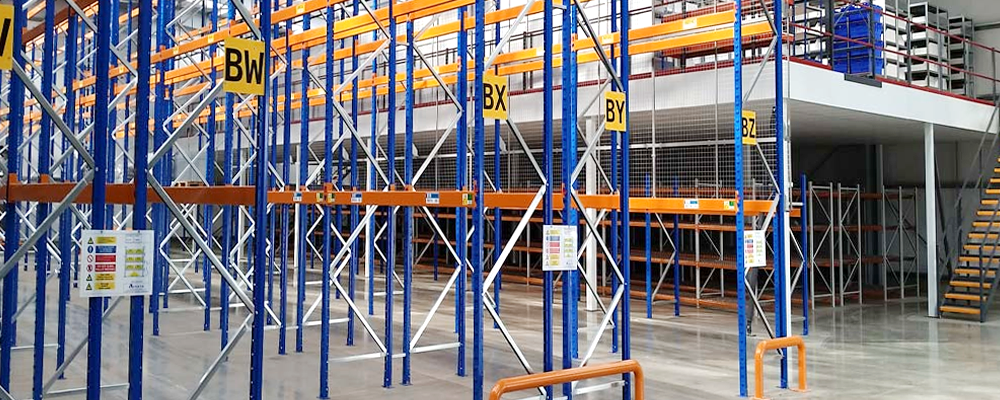
A mezzanine floor, and the correct pallet racking system, will prove an excellent way to create and utilise extra storage space for the business. Mezzanine floors can be used effectively to provide access, additional storage or workspace alongside a racking system. Such a configuration will increase storage space at the facility substantially without additional building expansion, so a growing operation can be accommodated in its existing real estate.
When it comes to pallet racking systems for mezzanine floors, one of the most effective solutions is the rack-supported mezzanine floor; this could be a partially supported or fully supported structure. In simple terms, pallet racking is integrated in the floor space below the mezzanine level so that it supports the upper floor and its contents. The support does not solely come from the pallet racking structure, as this would be insufficient. Instead, steel floor support columns are strategically installed on the mezzanine floor to provide sufficient support for the level on top.
The idea behind pallet racking on mezzanine floors is to tap into the vertical storage potential of the facility without the need to sacrifice existing office or workspace. Normally, pallet racking on mezzanine floors is a custom-tailored project that is specific to your business needs.
How can pallet racking be protected from damage?
Generally speaking, there are three types of damage found on pallet racking systems: structural, chemical, and exposure damage. Whether all three (or none) are present on your pallet racking depends on its age and location as well as the nature of your business. If you operate outdoor pallet racking, then obviously exposure to the elements would attract minor damage like rust, discolouration, or brittleness of plastic components. Regular maintenance should easily take care of such issues. Structural damage is quite a major problem; knocks and bumps from handling equipment as well as overloading and aging can compromise the structural integrity of pallet racking.
At the moment, there are distinct types of passive protection available in the form of guard rails, shock absorbing barriers, etc. A sufficient number of strategically placed anti shock barriers will provide a decent measure of protection. In the case of aging, the replacement and repair of fatigued elements is the only way to resolve the situation. Depending on the nature of your business, chemical damage might also be a factor; spills or contact with acids and other corrosives may weaken certain elements of the structure.
Chemical protection treatments are available for both metal and composite materials.
How do I maintain pallet racking?
Looking after your pallet racking is essential for risk-free operations. Faulty or damaged pallet racking can spell big trouble for the business. Generally, pallet racking is quite a sturdy piece of kit and shouldn’t require large amounts of maintenance. At the same time though, racking is susceptible to specific types of damage (caused by a forklift bump, for instance). Provided the racking is free of rust or any damage caused by corrosive chemicals it’s come in contact with, operators can apply a simple but effective maintenance checklist to ensure the structure is in good nick.
First up, note the section of aisle being inspected; this will help with maintenance scheduling. Next up, examine the structure’s framework, namely uprights and front/rear posts, baseplates, braces and fixings, shims, etc. Following this is the need to inspect horizontal beams and their bracing.
Last but not least, be sure to check any other parts such as decking and column guards, anti-collapse mesh, etc. as these also need to be in tiptop condition. Do not forget to ensure any safety and load bearing signage is in place and clearly seen by staff. Any damage discovered on the structure must be logged and repaired without delay.
Does pallet racking need inspecting?
Absolutely. Pallet racking must be inspected on a regular basis in order to identify and isolate any structural or other problems stemming from its everyday use. In all instances, a detailed structural integrity inspection must be conducted after knocks and bumps sustained by moving equipment like forklifts. Safety inspections must be carried out on a fixed schedule basis, depending on the amount of use the racking sees. These inspections could be weekly, fortnightly, or monthly. A full annual inspection covering the entire structure must be conducted by a SEMA, or SEMA-authorised subcontractor. The most effective way to conduct a pallet racking inspection is to go by a pre-determined checklist. If you are unsure about what items need to be included in the inspection checklist, consult with SEMA directly or speak to a qualified pallet racking manufacturer (ideally the company which installed your pallet racking).
The regular safety inspections of existing pallet racking are both a necessity and a law-imposed requirement for all operators. All obligations and responsibilities, as well as guidance on effective pallet racking maintenance, are listed in the UK Government’s HSG76 document on warehousing and storage safety. In all cases, a detailed written report must be compiled outlining the finds of every inspection.
Should I buy used pallet racking?
You can buy used pallet racking for your business, but the real question is should you buy used pallet racking. The unknowns of using second-hand pallet racking cannot be ignored, so the advice from the professionals is to refrain from used pallet racking unless absolutely necessary. Nowadays, manufacturers and installers are quite flexible, so a new pallet racking system on finance might be a more viable option for your business. Leasing a new pallet racking system is also an avenue worth exploring as you can opt for a different system at the end of the lease, which in turn gives you access to new equipment.
The main concern with used pallet racking is obviously its service history. In many instances, it is unclear whether or not the system has suffered from any damage or abuse that may have compromised it. Also, there is the question of whether all the essential components are of good quality and still within usable age. You might come across used pallet racking sold with a warranty, and although this might be a tempting option as having the warranty offers perceived extra peace of mind, it is still advisable to choose brand-new racking systems instead for a solution that meets your specific needs and doesn’t present any unknowns regarding safety.
Can pallet racking be moved?
Yes, most pallet racking systems can be shifted from A to B, in both theory and practice. However, it is a complex process so relocating an existing pallet racking system from one spot to another must be carried out by qualified engineers. As expected, the more complex the racking set up, the more complex the relocation process. The first stage of moving a pallet rack is dismantling it; the system cannot be shifted as a whole. Taking apart one such structure can be risky, so do not undertake the operations at your own initiative.
Normally, this is done outside of business hours in order to minimise operational disruption and reduce business downtime. Do not forget that suitable storage arrangements must be in place for the stock that is normally housed by the pallet racking. The next stage would be an assessment of new location. If the flooring and surrounding infrastructure will tolerate the pallet racking system, then the relocation can go ahead. The final stage of the moving process would obviously be reassembly at the new location. The system must be assembled in the correct way to ensure continuing safe daily use. Restocking the pallet racking is the last order of business.
Can pallet racking be used outdoors?
The short answer to this question is a simple yes. Having said that, outdoor racking is different from its indoor counterpart. Visually and functionally, external and internal pallet racking systems are not that different. However, they differ greatly in terms of resilience and durability. In the case of indoor pallet racking, the chances are the system is treated with fire retardant/resistant paints and perhaps chemical resistance treatment (if necessary).
Outdoor racking though utilises a different treatment known as hot dipping, or galvanisation. In simple terms, galvanisation is a process during which metals are dipped into molten zinc (which is super-hot) in order to make them corrosion resistant – essential for outdoor use. Galvanised outdoor pallet racks give operators excellent durability and resilience against the elements. It should be noted that for best results and optimal longevity, galvanised pallet racking must be exposed to cycles of wet and dry weather, which strengthen its protective coating. On the same note, if the coating is broken then the galvanisation properties will also diminish, in time developing rust. Elements with broken or missing coating must be replaced in a timely manner in order to ensure a longer lifespan and safe everyday operation of your pallet racking.